
Light-Struck Beer: Skunky Flavor, Causes & How to Prevent It

Light-struck (or “skunked”) beer smells like skunk spray or burnt rubber, and it’s caused by a photochemical reaction — not bacteria or production issues like many other off-flavors. UV and blue light break down iso-alpha-acids from hops, and the resulting compound is detectable almost instantly, even in trace amounts.
What Is Light-Struck Beer?
“Light-struck” describes beer that’s been exposed to UV or blue light and developed a skunky, burnt-rubber, sulfur-like aroma. Unlike most off-flavors, it isn’t a fermentation or sanitation issue — it’s a direct photochemical reaction between light and the hop compounds in the beer, and it can happen in seconds to minutes under direct sunlight, or minutes to hours under fluorescent lighting.
Quick facts:
- Flavor/aroma: skunky, burnt rubber, sulfur
- Compound responsible: 3-methyl-2-butene-1-thiol (MBT)
- Sensory threshold: ~4–7 ng/L (parts per trillion) – among the lowest thresholds of any off-flavor, making it almost instantly detectable
- Speed: near-instantaneous; direct sunlight can skunk a beer in seconds to minutes
- Most at risk: hop-forward beers
What Causes Light-Struck Beer?
Skunking happens when beer is exposed to UV and/or blue light (roughly 350–500nm) – most commonly sunlight, but fluorescent lighting can do it too, just more slowly.
- Clear or green glass bottles — neither offers meaningful protection from UV or blue light, which is why skunking is so common in green- and clear-bottled beers
- Direct sunlight exposure — the fastest path to a skunked beer, acting in seconds to minutes
- Fluorescent lighting — a slower path (minutes to hours), but still enough to skunk beer sitting in a display cooler or under store lighting
- Hop-forward recipes — more iso-alpha-acids means more raw material for the reaction
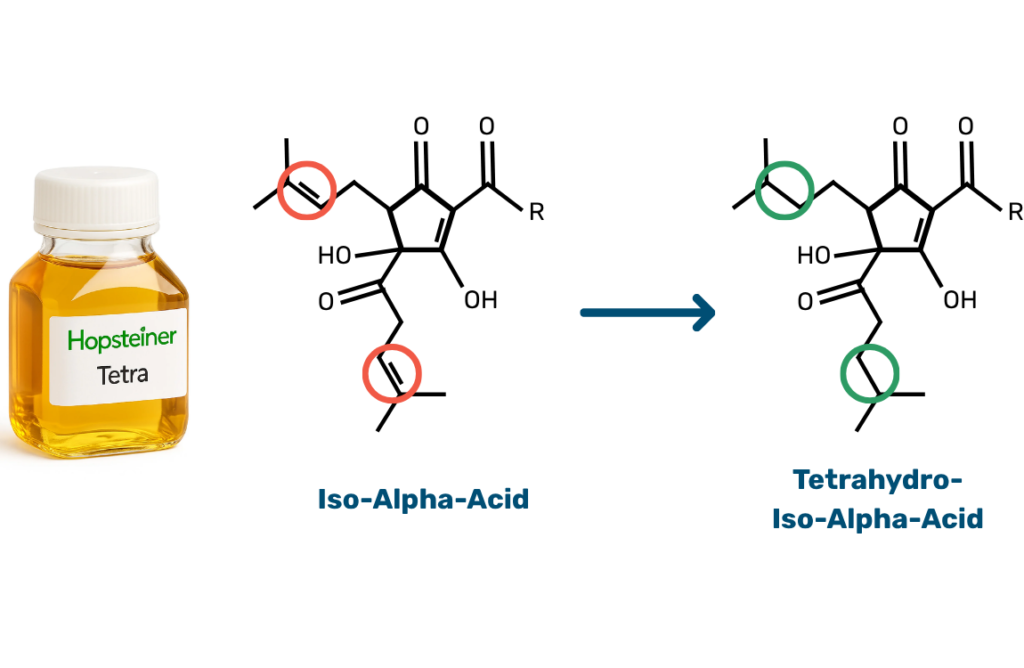
The chemistry: light radicalizes riboflavin (vitamin B2), which acts as a photosensitizer. That radical (unpaired electron) cleaves the side chain of iso-alpha-acids, forming a 3-methyl-2-butenyl radical. That radical then binds with any available sulfur source (hydrogen sulfide, sulfur ions, amino acids, etc.) to form MBT – the compound responsible for the skunky aroma.
How to Prevent Light-Struck Beer
Because the reaction depends on light reaching the beer, prevention comes down to blocking light or removing the vulnerable iso-alpha-acids:
- Use brown glass bottles or cans — brown glass blocks the UV and blue wavelengths that drive the reaction; clear and green glass do not. Cans, obviously, block all light from reaching the beer.
- Keep beer out of direct sunlight — including during transport, storage, retail display, and consumption
- Use tetra hop products — light-stable hop extracts that add bitterness without the skunking risk
Why tetra hops work: tetra hop products are tetrahydro-iso-alpha-acids – hydrogenated versions of standard iso-alpha-acids (aka with extra hydrogen atoms added). That extra hydrogenation prevents radical cleavage of the side chain, so even when riboflavin is radicalized by light, the reaction that produces MBT can’t proceed. This is how commercial brewers like Miller High Life can package beer in clear glass without it skunking.
FAQ
What does light-struck beer smell like? Skunk spray or burnt rubber, with a sulfur-like edge. It’s one of the most recognizable and lowest-threshold off-flavors in beer.
Can light-struck beer be fixed? No. Once MBT has formed, the reaction can’t be reversed. Prevention – brown glass, cans, keeping beer out of light, or using tetra hops – is the only real defense.
Why do some beers in clear bottles not taste skunky? Brewers using clear or green glass, like Miller High Life, typically use tetra hop products instead of standard hop extracts or pellets. Because tetra hops are hydrogenated, light exposure can’t trigger the reaction that produces MBT.
Is light-struck beer safe to drink? Yes — it’s an aesthetic off-flavor, not a safety issue. It just tastes and smells unpleasant.