
Isovaleric Acid in Beer: Cheesy, Sweaty Flavor & How to Prevent It

Isovaleric acid is the compound behind a cheesy, sweaty, old-hop flavor in beer. It forms when hop resins oxidize or when Brettanomyces or bacteria metabolize amino acids during long fermentation or aging. While it’s a flaw in most styles, low levels can read as an appropriate background note in some Lambics or mixed-ferm sours.
What Is Isovaleric Acid?
Isovaleric acid is a short-chain fatty acid best known for its sweaty-sock, aged-cheese character. It comes from either the oxidation of hop resins (such as in aged hops) or as a metabolic byproduct of Brettanomyces or spoilage bacteria.
Quick facts:
- Flavor/aroma: cheesy, sweaty, old hops
- Sensory threshold: ~0.1–1.5 ppm
- May be stylistically appropriate: as a subtle background note in some Lambics, mixed-fermentation sours, or Old Ales
- Two distinct origins: hop oxidation (chemical) and microbial metabolism (biological)
What Causes Isovaleric Acid in Beer?
Isovaleric acid has two largely independent causes — one chemical, one microbial.
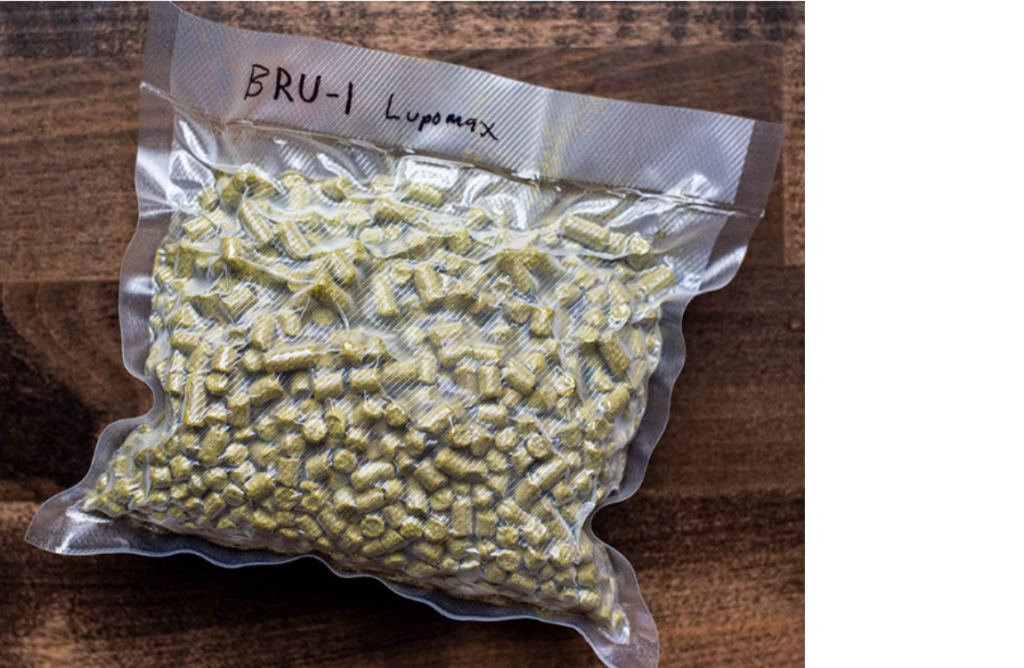
- Oxidation of hop resins — Isovaleric acid forms when hop alpha acids and resins oxidize. Hop deterioration accelerates with oxygen, heat, light, and time; the more of these four factors present together, the faster it happens. Whole-cone hops are especially vulnerable — pelletizing compresses hops so only about 5% of their surface area is exposed to the environment, while loose whole cones expose far more surface and can show measurable degradation in just a few months.
- Brettanomyces — Clean Saccharomyces reduces isoamyl aldehyde into isoamyl alcohol. Brettanomyces instead oxidizes that same aldehyde into isovaleric acid. This reaction is slow: in mixed-fermentation beers and barrel-aged wines, isovaleric acid often doesn’t reach detectable levels until 12+ months of aging.
- Bacterial contaminants — Spoilage bacteria can metabolize leucine (which makes up roughly 4.5% of barley’s amino acids and is otherwise a key yeast nutrient) into isovaleric acid as a metabolic byproduct.
How to Prevent Isovaleric Acid
Because the two causes are unrelated, prevention splits along the same lines:
- Store hops properly — cold, oxygen-excluded, and away from light to slow resin oxidation; this matters even more for whole-cone hops
- Use hops promptly — minimize time between harvest/purchase and brew day, especially for whole cones
- Practice good sanitation — prevent wild Brettanomyces and spoilage bacteria from entering fermentation or aging vessels
- Manage long-aging programs deliberately — if you’re intentionally using Brett or doing extended barrel aging, monitor carefully beyond 12 months, since isovaleric acid can develop late and gradually
FAQ
What does isovaleric acid taste like in beer? Cheesy, sweaty, or reminiscent of old hops — often described as a “gym sock” character at higher concentrations.
Is isovaleric acid in beer bad? Usually, yes — it’s typically a sign of oxidized hops or microbial contamination. In small amounts, though, it can be an acceptable, even expected, background note in some Lambics, mixed-ferm sours, and Old Ales.
Can isovaleric acid be removed once it’s formed? Not really. Unlike acetaldehyde, isovaleric acid isn’t something healthy yeast will reabsorb and metabolize, and it volatile enough to make scrubbing effective. Prevention (hop storage and sanitation) is the main lever, not correction after the fact.
Does isovaleric acid always mean the beer is contaminated? No. It can also form purely from hop oxidation with no microbial involvement at all. The sensory result, however, is the same.