
Oxidation in Beer: Causes, Stale Cardboard Flavor & How to Fix It

Oxidation is the most commonly produced off-flavor in commercial brewing, and it’s the culprit behind a dull, stale, wet cardboard, papery, or sherry-like character in beer. It happens when oxygen exposure – either in hot wort or after fermentation – chemically binds to compounds in the beer, only to be released later as staling aldehydes. Oxidation is catalyzed by both light and heat, and once it starts, the more oxygen present, the faster the beer stales. Oxidation is irreversible – there is no fix once it’s happened, which is why prevention at every stage is the only real defense.
What Is Oxidation?
First, there’s an important distinction between aerating and oxidizing. Aerating – dissolving oxygen into cool wort before pitching – is necessary and desirable; yeast need it to synthesize sterols and unsaturated fatty acids for healthy growth. Oxidizing – exposing hot wort or finished beer to oxygen – is adding oxygen without purpose and outlet.
In hot wort, oxygen binds chemically to compounds instead of dissolving cleanly, then gets re-released later in the beer where it can oxidize fatty acids and alcohols. Once the wort is coolded, oxygen more easily and cleanly dissolves – remaining available of yeast useage. After fermentation, oxygen has no purpose (no yeast metabolism outlet) and chemically binds to compounds which, as with hot wort oxygenation, are later released and create staling compounds.
Quick facts:
- Aroma/flavor: dull, stale, wet cardboard, papery, sherry-like
- Appearance: light beers will darken to a murky brown; it will be hard to see a change in darker beers
- Most representative compound: trans-2-nonenal (threshold ~0.1 ppb) — longer aldehyde chains are even more potent
- Dissolved oxygen goal: < 25 ppb
- Hot-side cutoff: cool wort to below 80°F before aerating and pitching
- Note: slow, controlled oxidation is sometimes desirable — barrel-aged Lambics and Barleywines can develop complex flavor through it over long timeframes
Hot Side vs. Cold Side Oxidation
Oxidation risk exists at two very different points in the brewing process, and the fixes are different for each.
Hot Side Oxidation
Hot side oxidation happens between the end of the boil and pitching, while the wort is still warm.
- Cool rapidly to stop residual reactions and get through the 90–140°F danger zone quickly (about 15 minutes for 5 gallons) — this range supports the most microbial growth and leaves wort susceptible to oxidation damage as it cools
- Only aerate once the wort is cool (below 80°F) — aerating hot wort causes oxygen to bind chemically rather than dissolve, and that bound oxygen is released later in the beer where it oxidizes fatty acids and alcohols
- Boiling drives off dissolved oxygen that’s normally present in wort, so you are starting with a clean slate
- Cooling also produces a cold break, which forces proteins to permanently precipitate out and reduces chill haze later — hazy beer tends to stale faster, so a good cold break has knock-on benefits for oxidation stability
Side note about aeration levels: yeast need 8–16 ppm dissolved oxygen (strain dependent) to build sterols and unsaturated fatty acids for growth (multiplication). Too little and fermentation under-attenuates; too much and excessive yeast growth can increase diacetyl and fusel alcohols. Higher-gravity worts need more oxygen to support more yeast growth, but oxygen is also harder to dissolve at higher gravities.
Cold Side Oxidation
Cold side oxidation happens after fermentation, during transfers, conditioning, and packaging – and it’s the most common source of oxidation problems overall.
- Purge everything that will touch beer to minimize oxygen pick-up: brite tanks, hoses, and cans/bottles should all be purged with CO2 or N2 before use
- Minimize turbulence during any post-fermentation transfer, splashing and agitation drive oxygen pickup – especially in an incorrectly or not-at-all purged vessel
- Ensure a good foam cap on cans and bottles before sealing – foam displaces headspace oxygen and protects the beer
![three photos of beers being filled on a canning line. The labels read "not enough [foam]", "overkill", "Just right [level of foam]".](https://imbibe-solutions.com/wp-content/uploads/2026/09/Graphics-3-2026-30-1024x668.png)
What Causes Oxidation?
- Oxygen exposure after fermentation — the most common cause of oxidation overall
- Aeration of warm wort — oxygen binds chemically instead of dissolving cleanly, then releases later in the beer
- Unpurged tanks and lines — contact with air allows for oxygen exposure
- Bad foam caps during packaging — insufficient foam leaves oxygen-filled headspace in cans and bottles; watch for frog-eye bubbles as they will pull a lot of O2 into the beer!
What Happens When Beer Oxidizes?
Different compounds oxidize into different off-flavors:
- Oxidized lipids → stale character
- Oxidized melanoidins (formed during malting and the boil) → sherry-like character
- Oxidized ethanol → almond-tasting aldehydes — this is also why wort should never be aerated to try to fix a stuck fermentation
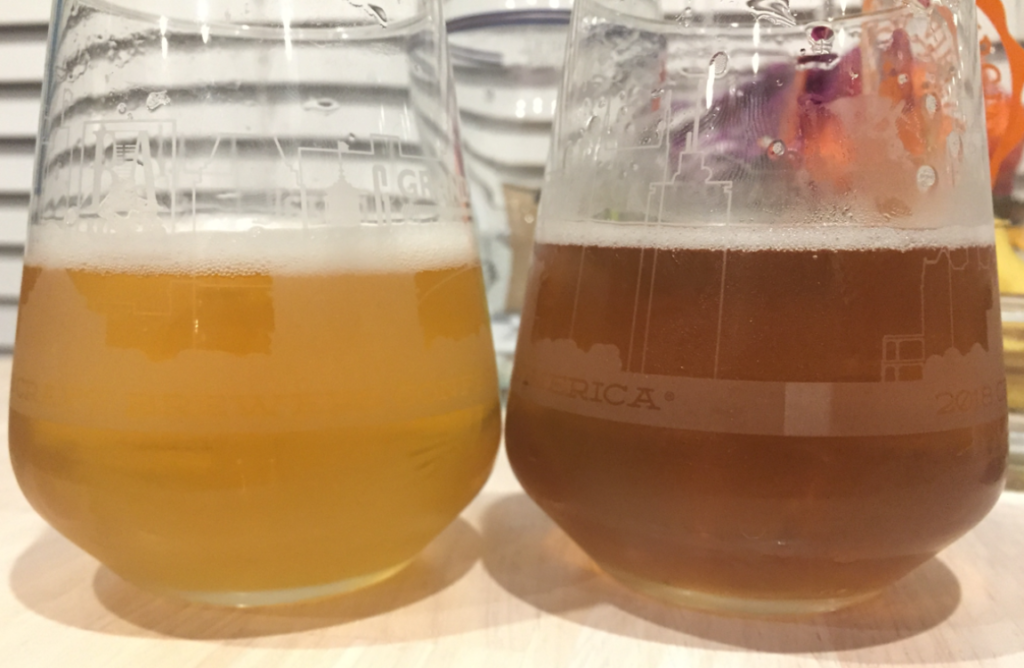
The color will also darken in light beers. The photo below is two different cans of the same beer, packaged on the same day. The pour on the left was in good condition, but the pour on the right was severely oxidized – meaning it was exposed to a lot of oxygen during packaging (they came from the same tank after all). It is imporant to monitor dissolved oxygen during packaging and check every fill head, as they may function differently.
How to Prevent Oxidation
- Minimize exposure — cool wort quickly and purge everything that comes in contact with the beer
- Aerate, don’t oxidize — only aerate wort once it’s below 80°F, never while it’s hot
- Minimize turbulence in tanks and packages during transfers
- Ensure good foam production before sealing cans or bottles
- Use oxygen-scavenging caps if bottling
- Test dissolved oxygen immediately after any exposure — oxygen binds quickly when cold, so delayed testing will under-report it. Target < 25 ppb.
FAQ
What does oxidation taste like in beer? Dull, stale, wet cardboard, papery, or sherry-like. It’s the most common off-flavor problem in commercial brewing.
What causes oxidation in beer? Most often, oxygen exposure after fermentation – through unpurged tanks and lines, turbulent transfers, or poor foam caps during packaging. Aerating wort while it’s still hot is another major cause, since the oxygen binds chemically and is released later in the beer.
Is oxidation in beer ever desirable? In select cases, yes. Slow oxidation during long-term barrel aging of Lambics or Barleywines can bring out complex, sherry-like flavors and support aging. Outside of that, oxidation is a flaw.
How do you prevent oxidation in beer? Cool wort quickly through the 90–140°F danger zone, only aerate below 80°F, purge all tanks/hoses/cans with CO2 or N2, minimize turbulence during transfers, and ensure a solid foam cap before sealing packages.
What’s the difference between aerating and oxidizing wort? Aerating is dissolving oxygen into cool wort so yeast can use it for healthy growth. Oxidizing is oxygen binding chemically to hot wort or finished beer, where it’s released later and damages flavor and color. The cutoff for preventing hot-side oxidation is 80°F.